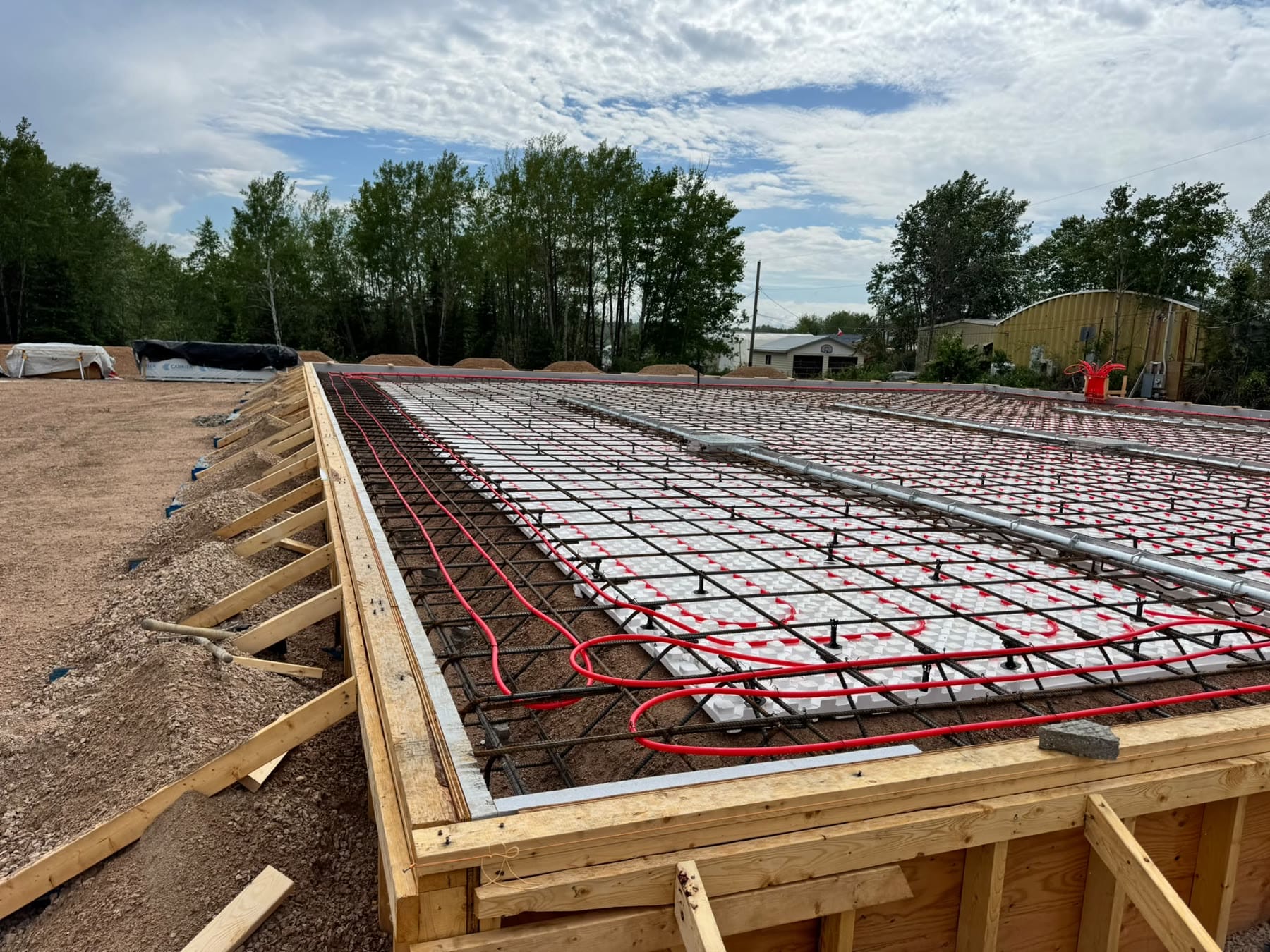
If you work in your shop through a Manitoba winter, the floor is where you feel the cold first. In-floor heat warms the slab itself, so the heat comes up from where your boots, tires and tools sit. This guide covers how it works in a shop and what you need to decide before the concrete is poured.
How in-floor heat works
A heated slab is a concrete floor with plastic tubing buried in it. Warm water runs through the tubing, the concrete soaks up the heat, and the whole floor gives it off slowly and evenly. The tubing is PEX, the same flexible pipe used in many house plumbing and heating systems. There are no vents and no blowers, so the air does not get dried out and dust is not pushed around the shop.
A heated floor is also very good at one job that farmers and truck owners care about: drying out a wet vehicle. Snow melts off a truck parked on a warm slab, and the puddle dries instead of sitting there until spring.
What goes into the floor
A heated pad is built in layers, and every layer is put down before any concrete arrives. Compacted gravel goes down first, then a 6-mil poly vapour barrier, then rigid foam insulation board. The PEX is laid on top of the foam in loops and tied to the rebar so it cannot float or shift when the concrete is placed. The foam matters: it keeps the heat travelling up into the shop instead of down into the cold ground. Our concrete pad guide explains the frost walls, rebar and vapour barrier that sit around this.
The ends of every loop come back to a manifold, which is the point where your heating contractor later connects the heat source. We rough in the tubing and manifold during the pour, so the floor is ready to be connected afterwards.
Why it has to be planned now
This is the most important thing to know: you cannot add in-floor heat to a slab that has already been poured. The tubing has to be in the concrete. Cutting up a finished floor to install it is not a practical fix, so the decision belongs at the design stage, before the pour is booked. If you are not sure yet, say so when you design your shop, because it is far easier to leave the option open than to go back.
It also pays to think about the floor before you finish the inside. Anything you drill or saw into a heated slab, such as anchor bolts for a hoist, a lift or heavy shelving, can hit a loop. Ask where the loops run and keep a drawing of the layout.
Where the heat comes from
The slab needs a heat source to warm the water. A boiler or a water heater with a pump is the usual answer, and it is installed and connected by a heating contractor, not by us as part of the concrete work. Some owners connect the system to a fuel they already have on the property, and some choose a dedicated unit. This is a decision for you and your heating contractor, and it is worth having that conversation before the pour so the manifold ends up in a sensible spot.
Zones, thermostats and how it behaves
A big shop does not have to heat evenly from wall to wall. The loops can be split into zones, so a maintenance bay can be warm while a storage bay stays cool, with each zone controlled on its own. Many farm shops are laid out exactly this way: one heated working area and unheated bays for seasonal equipment. See our farm shop page for how that is usually arranged.
A slab holds a lot of heat, which means it warms up and cools down slowly. It is best run at a steady setting rather than switched on only when you walk in. If you need the shop warm in minutes on a -30 morning, many owners add a small unit heater on top of the floor heat for fast warm-up and let the slab do the steady work.
The rest of the shop has to keep the heat in
A warm floor in a poorly insulated building is wasted effort. Our complete packages include R22 wall insulation, R50 ceiling insulation, a vapour barrier and an interior metal liner, so the heat stays where you want it. For a building you plan to heat all winter, the stud frame is the most practical frame because the deep walls take insulation well, and our guide to insulating a shop goes through the options. A post frame shop can be heated too, with the extra step of lining and insulating the walls.
How to plan for it
Tell us at the design stage that you want heat in the floor, and say which parts of the building should be heated. Open the free 3D designer, set your size and doors, and we will take it from there. If you would like to talk it through first, book a free call. Either way, mention in-floor heat when you design, so it is on the drawing from the start.
Common questions
Can I add in-floor heat to my shop after the concrete is poured?
Not in a practical way. The PEX tubing has to be laid on the foam and tied to the rebar before the pour, so the decision has to be made at the design stage.
Do I need a boiler for in-floor heat?
The tubing needs a source of warm water, usually a boiler or a water heater with a pump. Your heating contractor connects it to the manifold we rough in during the pour.
Can I heat only part of my shop with in-floor heat?
Yes. The loops can be split into zones, so one bay can be heated and another left cool, each with its own control.
Is in-floor heat worth it for a farm shop?
If you repair equipment or work in the shop in winter, a warm slab is one of the best upgrades you can make. It keeps the floor warm and dries wet vehicles without blowers.