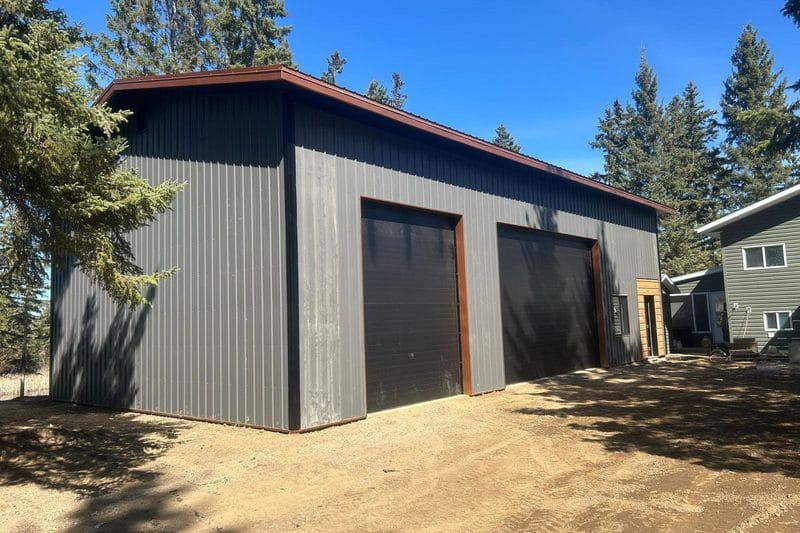
A machine shed has one job: keep expensive equipment out of the weather and easy to get at. Farmers use the words machine shed, equipment shed and farm shop for overlapping things, so this guide sorts out the differences and walks through the choices that decide whether the building works for you.
Machine shed or farm shop?
A machine shed is mainly for storage. Equipment goes in at the end of the season and comes out in spring, and the building is often not heated. A farm shop is where you work: repairs, welding, greasing and parts. Many operations build one of each, and many build a single building with a heated working end and an unheated storage end. Our farm shop page and cold storage page cover the two uses in more detail.
Start with the tallest and widest machine you own
Clearance is the first thing to get right. Write down the height and width of your largest machine with the boom folded, the cab raised or the implement attached, then add extra room for turning in and out. That number decides the overhead door. Post frame buildings take overhead doors from 8 to 24 feet wide, and stud frame can go up to 32 feet wide, so even a wide machine can be accommodated. Our farm shops are commonly built with 14 or 16 foot walls, and doors such as 16x14, 16x16 and 20x16 are common choices.
Do not size the door for the machine you own today. Equipment gets bigger with every upgrade, so allow for the next one.
Drive-through or one-way?
A door on each end lets you drive in one side and out the other without backing up or turning inside. For a long building that stores several machines in a row, this layout saves time every day of the season. It does need more door openings and a clear lane through the middle, so it affects the floor plan, which is why it is worth deciding before the design is drawn.
The frame: open spans without a forest of posts
For unheated equipment storage, a post frame building is the classic choice. Heavy posts carry the roof, so you can keep the interior open, and it goes up quickly. Our guide to pole barns in Manitoba explains the structure. If you need the widest possible clear span, with nothing between the walls, a steel frame removes the interior posts entirely and handles very wide buildings. If part of the building will be heated and finished inside, a stud frame section gives you flat walls that are easy to insulate. The frame type comparison shows how each one behaves.
The floor has to carry the load
A loaded grain cart or a combine puts a lot of weight on a small footprint. The slab should have reinforcement and be poured over a compacted base, with frost walls that go below the frost line, which is 4 to 5 feet down on the prairies. The slab is poured with rebar tied on a grid and anchor bolts set at engineered spacings. You can also leave the slab out of a cold storage building, and park on gravel, if you do not need a concrete floor. Our concrete pad guide explains why the floor matters.
Heated bay and cold bays
Most machine sheds do not need heat across the whole floor. A common plan is a heated bay for repairs with R22 wall and R50 ceiling insulation, a vapour barrier and an interior metal liner, and unheated bays beside it for storage. If you work on equipment through the winter, in-floor heat in the working bay is worth planning from the start, and the in-floor heat guide explains how it works.
Light, power and layout details
Polycarbonate panels let daylight into the building without windows that can break, and a few walk-in doors save you from opening a big overhead door every time you step in. Think about where the power panel, the compressor, the parts shelving and the fuel storage go, because those decide where the walls should be solid.
Next step
Tell us your equipment list and the door sizes you need. Design your shop free in 3D to try different sizes and door layouts, then book a free call and we will go through the layout with you. We work across Manitoba, Saskatchewan and Alberta.
Common questions
What is the difference between a machine shed and a farm shop?
A machine shed is mainly for storing equipment out of the weather. A farm shop is a place to work on equipment, and is usually heated. Many farms build one building with both.
How wide can the overhead doors be?
Post frame buildings take overhead doors from 8 to 24 feet wide. Stud frame buildings can use doors up to 32 feet wide.
Do I need a concrete floor in a machine shed?
Not always. For cold storage you can leave the slab out. If you will park heavy equipment or work in the building, a reinforced slab is the better choice.
Can part of a machine shed be heated?
Yes. A common layout has a heated, insulated repair bay and unheated storage bays beside it.